Google AdWords looks simple on the surface. You pick keywords, write an ad, set a budget, and wait for customers to arrive.
In reality, AdWords is a financial minefield.
One wrong setting, one poorly chosen keyword match, or one unchecked targeting option can drain your budget faster than you expect. PPC management services exist for one reason: to stop businesses from wasting money on avoidable mistakes.
Going solo might feel cost-effective, but it often ends up costing far more.
Why Google AdWords Is So Easy to Get Wrong
Google gives advertisers enormous control over how and where ads appear. That flexibility is powerful—but dangerous without experience.
AdWords doesn’t fail businesses. Poor configuration does.
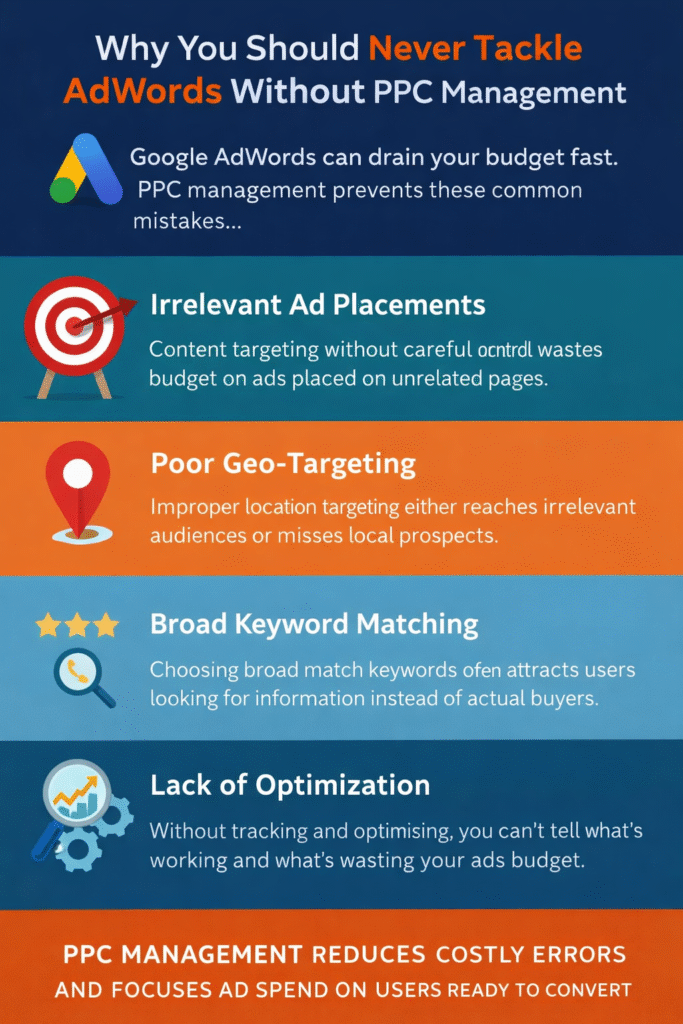
Content Network Targeting Mistakes
By default, Google enables the Content Network. To many advertisers, this sounds like “more exposure.”
The problem is targeting quality.
If you sell water purifiers and your ad appears on a page about water parks, that click may still cost you—even though the visitor has zero intent to buy. Each irrelevant click is pure budget loss.
Professional PPC management teams understand when to:
-
Disable content targeting
-
Segment campaigns properly
-
Control placements carefully
Exposure doesn’t equal conversions.
Geo-Targeting Errors That Waste Money
Geo-targeting is another common pitfall.
If you operate a local business, failing to restrict geographic targeting means you’ll pay for clicks from people who can never become customers. A swimming pool company in Florida gains nothing from clicks in Washington State.
On the other hand, if you sell digital products and restrict geography too tightly, you eliminate most of your market.
PPC management ensures your targeting aligns with how your business actually makes money.
Keyword Matching: The Silent Budget Killer
Google allows multiple keyword match types:
-
Broad match
-
Phrase match
-
Exact match
Many advertisers default to broad match because it feels safer.
In reality, broad match often attracts researchers instead of buyers. Someone searching “how to repair a swimming pool” is usually not hiring a contractor. Paying for those clicks rarely leads to revenue.
PPC managers control match types carefully to focus on:
-
Buyer intent
-
Commercial searches
-
Conversion-focused traffic
Tracking and Optimization: Where DIY Campaigns Fail
Most AdWords losses don’t come from one mistake—they come from not knowing what’s working.
Without proper tracking:
-
You don’t know which keywords convert
-
You can’t spot budget leaks
-
You can’t scale what works
PPC management teams monitor campaigns continuously, adjusting bids, ads, and keywords based on real performance data.
Why PPC Management Is the Smart Route
Professional PPC management is not about spending more—it’s about spending smarter.
A skilled team:
-
Prevents wasted clicks
-
Improves conversion quality
-
Protects your budget
-
Delivers measurable ROI
Google Ads can be profitable—but only when managed correctly.
FAQ
Why is PPC management important for Google Ads?
PPC management prevents costly mistakes, improves targeting, and ensures ad spend focuses on users who are most likely to convert.
Can small businesses run AdWords on their own?
They can, but most lose money due to poor targeting, keyword selection, and lack of performance tracking.
What is the biggest AdWords mistake businesses make?
Broad keyword matching and improper targeting are the most common causes of wasted ad spend.
Does PPC management increase ad costs?
No. It usually reduces wasted spend and improves return on investment over time.
How quickly can PPC management show results?
Paid ads can deliver traffic immediately, but optimization improves results steadily over weeks as data is collected.