
Maintaining a blog is one of the most effective ways to strengthen your online presence, improve SEO, and communicate consistently with your audience. Regular blog posting helps businesses establish authority, build trust, and keep their websites fresh in the eyes of search engines.
But what happens when you’ve just launched a new blog?
A brand-new blog can feel empty, unproven, and lacking credibility. That’s where backdating, when used correctly, can become a useful content strategy—not as a shortcut, but as a foundation-building tool.
Why Blog History Matters
Search engines and users alike respond better to blogs that show consistency over time. A blog with a visible publishing history:
-
Appears more established
-
Feels more trustworthy to readers
-
Signals stability and effort
-
Encourages deeper exploration
A brand-new blog with one or two posts can struggle to gain attention, even if the content is good. Backdating helps solve this early-stage perception problem.
What Is Blog Backdating?
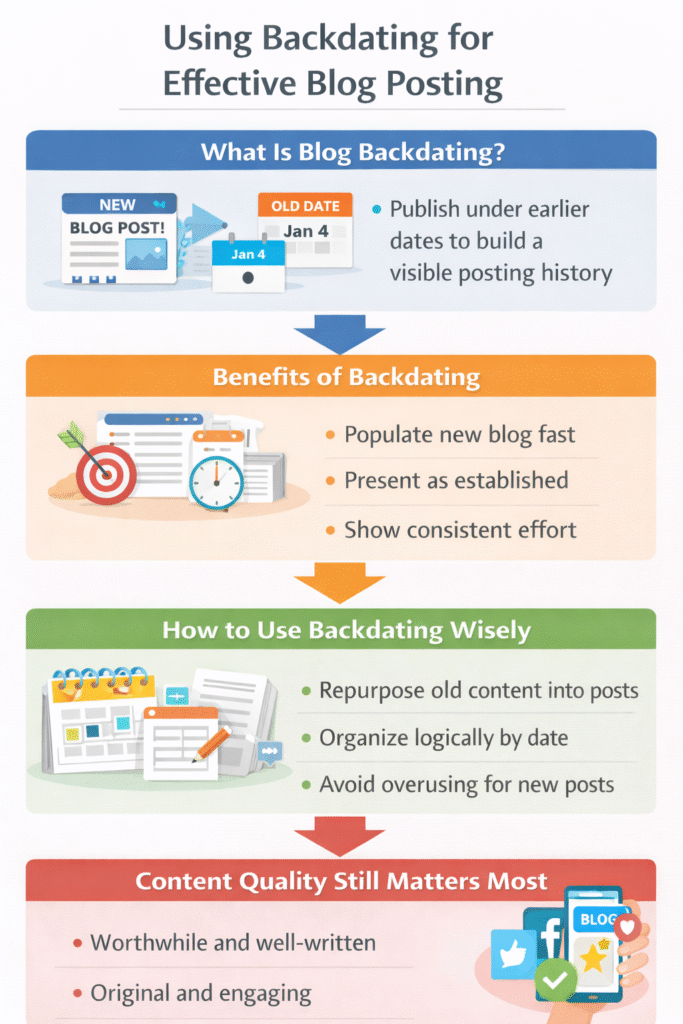
Backdating means publishing content under earlier dates instead of the current date. Most content management systems allow you to manually choose the publish date before making a post live.
When used thoughtfully, backdating allows you to:
-
Build a visible posting history
-
Organize older content logically
-
Populate a new blog quickly
-
Present your blog as active and developed
Backdating is not about deception—it’s about structuring content intelligently.
Adjusting the Time and Date Stamp
One of the simplest ways to use backdating is by adjusting the publish date before posting. If you’ve written several high-quality articles in advance, you can schedule them across earlier dates.
This creates:
-
A natural posting timeline
-
Better navigation for readers
-
A more complete archive
Instead of releasing everything at once, backdating spreads content across time, making the blog feel more mature.
Filling a New Blog with Existing Content
If you already have a website with strong written content, you don’t need to start from scratch.
You can:
-
Repurpose service page content into blog posts
-
Expand FAQs into full articles
-
Rewrite informational pages as educational blogs
Backdating these posts helps populate your blog quickly while maintaining quality and relevance.
When Backdating Works Best
Backdating is most effective when:
-
Launching a brand-new blog
-
Migrating content to a new site
-
Rebuilding a blog after redesign
-
Organizing evergreen content
In these cases, backdating supports structure and readability rather than manipulating rankings.
Using Backdating Wisely
Backdating does come with trade-offs. Older-dated posts don’t appear as “new,” which means:
-
Fewer initial comments
-
Less homepage visibility
-
Reduced short-term engagement
However, for new blogs, the benefit of establishing history often outweighs the downside. Visitors exploring older posts still see value—and credibility builds over time.
Content Quality Still Comes First
Backdating alone doesn’t create trust. Content does.
Every post—backdated or not—must:
-
Provide real value
-
Be well-written and clear
-
Address user intent
-
Reflect your brand voice
Search engines and users quickly recognize shallow or recycled content. Backdating works only when paired with strong, original material.
Backdating and SEO: What Really Matters
Search engines care more about content quality and relevance than the publish date. Backdating won’t harm SEO if:
-
Content is original
-
Pages are indexed naturally
-
Internal linking is logical
-
User engagement remains healthy
When used responsibly, backdating supports structure—not manipulation.
Frequently Asked Questions
Backdating?
Backdating means publishing blog posts under earlier dates to create a visible posting history and organize content logically.
New blogs?
Yes. Backdating is especially useful for new blogs that need credibility and structure from the start.
SEO impact?
Backdating does not harm SEO when content is original, relevant, and valuable to users.
Existing content?
You can safely repurpose and backdate existing website content as blog posts if rewritten properly.
Risks?
Overusing backdating can reduce early engagement, so it should be used strategically, not excessively.
Ready to Grow with Smarter Blog Publishing?
A strong blog isn’t built overnight—it’s built with consistency, structure, and strategy. When used wisely, backdating can help you launch confidently, present credibility, and focus on what matters most: delivering valuable content to your audience.
If you’re ready to build a blog strategy that supports SEO and long-term growth, NerdsAndGeeks Contact can help you plan, publish, and optimize with confidence.