
In the “old days” of 2009, during the height of EzineArticles, BUM marketing, and large-scale article writing and distribution, nobody really had a polished name for what marketers were doing. People were writing content in massive volumes and publishing it everywhere simply because it worked—not because it was elegant or well branded.
By 2010 and 2011, slightly better labels began to appear, such as article marketing or SEO content production. But it wasn’t until the early 2010s that the process of writing valuable content and distributing it strategically across the web was finally given a modern, respectable name: content marketing.
Same foundation. Smarter execution. Much stronger long-term results.
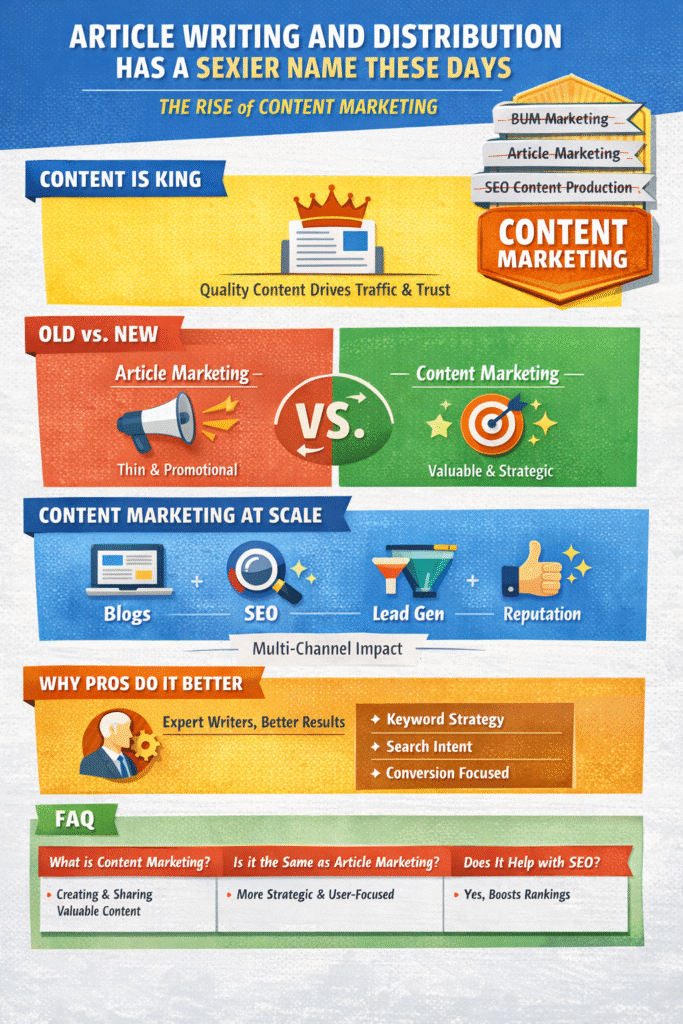
Content (Marketing) Is King
The phrase “content is king” has survived every algorithm update for a reason—it has always been true. If you want to win online, you need content. Not just a few pages, but a consistent flow of useful, relevant material that answers real questions and builds trust.
Early affiliate marketers proved this through sheer volume. They would pick a product, build a simple website, and publish five to ten articles per day, every day, for weeks. With modern SEO standards requiring hundreds of words per article to avoid thin-content penalties, that often meant producing more than 50,000 words per month.
It wasn’t glamorous—but it worked.
Why Content Marketing Works Better Than Old-School Article Marketing
What separates modern content marketing from old article distribution tactics is intent. Today’s content isn’t written just to exist—it’s written to serve a purpose.
Content marketing helps businesses:
-
Build authority in their industry
-
Attract consistent organic traffic
-
Support SEO, branding, and conversions at the same time
-
Funnel readers naturally toward products or services
Instead of thin promotional posts, modern content focuses on education, clarity, and value—earning attention rather than forcing it.
Content Marketing at Scale
When content marketing is done consistently, it becomes far more than a traffic tactic. It becomes infrastructure.
Publishing across blogs, industry sites, resource hubs, and editorial platforms creates an ecosystem where every piece of content supports the others. Over time, this ecosystem fuels SEO, lead generation, reputation management, and sales—all without relying on paid traffic.
This is why content marketing remains one of the most powerful long-term strategies in digital marketing.
Why Professional Content Makes the Difference
Writing at scale isn’t just about typing faster. It’s about knowing what topics matter, how users search, and how content fits into a broader SEO and conversion strategy.
Experienced content creators understand search intent, keyword layering, internal linking, and structure—turning written content into a measurable business asset rather than just words on a page.
FAQ
What is content marketing?
Content marketing is the practice of creating and distributing valuable content to attract, engage, and convert a specific audience over time.
Is content marketing the same as article marketing?
Article marketing is an early form of content marketing. Modern content marketing is more strategic, user-focused, and aligned with SEO and conversions.
Does content marketing still help with SEO?
Yes. High-quality, consistent content remains one of the strongest drivers of long-term SEO success.
How much content does a business need?
There’s no fixed amount, but consistency matters more than volume. Publishing relevant content regularly builds authority faster than occasional posting.
Can content marketing increase sales?
Absolutely. Content supports every stage of the buyer journey, from awareness to trust to conversion.
Ready to Use Press Releases the Right Way?
A modern press release service is fast, powerful, and impactful—but only when used correctly. With strong content, proper SEO, and real news value, press releases can elevate your brand instantly.
👉 Contact NerdsAndGeeks today to create press releases that deliver real visibility and results.